

What are trading bots?
In crypto, trading bots are often marketed as an “autopilot for profits”. In practice, a bot is simply the automation of predefined rules: when to buy, when to sell, which order types to use, how often to act, and under what conditions to stop. A bot can remove routine work and reduce some emotional decision-making — but it does not turn a weak idea into a strong strategy, and it does not eliminate market costs.
This article is an honest breakdown of trading bots on MEXC, CoinW, HTX and Toobit: their real pros and cons, and how much bots “work” on average, in the way people usually mean it.
Where these exchanges have bots — and whether you can connect external bots
On large centralised exchanges, you typically see two approaches: built-in bots inside the interface and external bots connected via API.
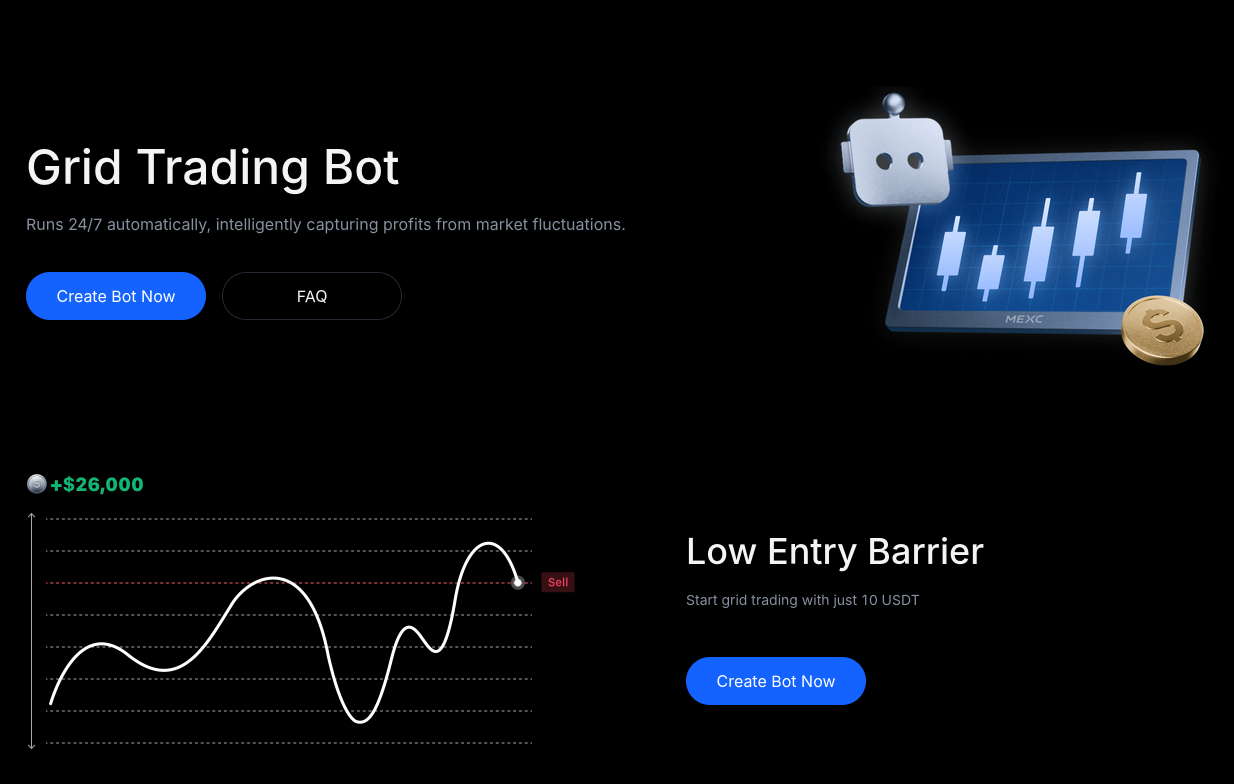
MEXC offers built-in trading bots, including grid solutions, and provides official API infrastructure for integrations.
MEXC: https://promote.mexc.com/r/Rl72m1XG
CoinW has a dedicated “Trading Bots” section and a “showcase” of strategies, and it also publishes official API documentation, which makes connecting external bots technically possible.
CoinW: https://www.coinw.com/ru_RU/register?r=26184209
HTX provides a “Trading Bot” feature with official guides and separate OpenAPI documentation, which also supports third-party integrations.
HTX: https://www.htx.com/invite/ru-ru/1f?invite_code=c94e8223
Toobit includes a “Trading Bot” section and bot materials in its help centre, and it also publishes API documentation.
Toobit: https://www.toobit.com/ru-RU/register?invite_code=YyhCwb
What is a trading bot in reality?
In most cases, a “trading bot” is not artificial intelligence — it’s automated execution of a fixed logic. The most common formats are grid bots, time-based averaging (DCA), and aggressive averaging schemes.
A grid bot tries to profit from oscillations within a range: it buys lower and sells higher, locking in small profits repeatedly. DCA and auto-invest are closer to accumulation discipline: the bot buys on a schedule, averaging the entry price. Martingale is the riskiest class: when price moves against the position, the bot increases size hoping for a reversal.
Why do bots look so appealing?
The main advantage is discipline and 24/7 execution. A bot doesn’t get tired, doesn’t miss moves, and doesn’t “change its mind” at the wrong moment. For grids and regular buys, that can be genuinely useful: less manual work and fewer emotional decisions.
Another benefit is repeatability. When rules are fixed, you can compare settings and see what actually drives results. That’s different from manual trading, where part of the outcome comes from emotions and ad-hoc changes to the plan.
The key downsides people don’t usually mention
The biggest downside: a bot doesn’t create returns “out of thin air”. It doesn’t make a strategy profitable — it just executes it. If there’s no edge after fees and slippage, the bot will systematically reproduce negative expectancy.
Grids are especially sensitive to costs because profits are often small and generated across many trades. Fees, spread and slippage can eat most of the outcome — and sometimes flip it into a net loss.
The second major risk is the market regime. Grid strategies like range-bound markets. When the market enters a strong trend, a grid can get stuck in drawdown on spot, or face liquidation on futures when leverage is used. Research on grid approaches often highlights that a “classic” grid without adaptation and risk logic is not a profit machine; improvements typically require dynamic adjustments.
The third risk is futures and leverage. Many futures bots create a dangerous illusion of stability: they show small steady gains for a long time, then one sharp market impulse wipes out what’s been accumulated due to margin requirements, averaging, or a poorly chosen range.
A separate issue is “AI bots with guaranteed returns”. Regulators explicitly warn that such promises are often used as marketing cover in fraudulent schemes. If someone promises stable percentages with no risk, that’s almost always a signal to stop.
Do bots work — or is it a utopia?
If “work” means “execute actions”, then yes: exchange bots really do automate order placement and rule-following.
But if “work” means “make most people profitable”, the statistics on active trading are sobering. Academic studies on day trading performance (including futures markets) show that the vast majority of participants lose money over time; one well-known study notes that among those who traded for longer periods, an overwhelming majority ended up negative.
Crypto markets are highly volatile and can sometimes produce favourable windows for certain strategies. But the underlying maths remains: fees, the risk of rare “fatal” moves, and the lack of a stable edge make “auto-profit” uncommon.
The correct framing is: a bot is a useful automation tool — but it’s a utopia as a “guaranteed income source”.
How to use bots sensibly
If you want to use bots as a tool rather than a fantasy, the core focus is risk management and realistic expectations.
At the start, spot scenarios without leverage are safer, especially for grids. With grid, you need to decide what happens if price exits the range: hold the position, rebuild the grid, or close with a capped loss. For external API bots, it’s critical to set permissions correctly: minimum rights, no withdrawal permissions, and (if possible) IP whitelisting for the key.
Most importantly, judge results by the full profile, not by “green days”: maximum drawdown, recovery time, fee impact, and behaviour during sharp market moves.
Summary
On MEXC, CoinW, HTX and Toobit, trading bots are available as built-in functionality, and external connections via API are also possible.
Bots are not magic. They bring discipline and automation, but profitability is determined by strategy, costs and risk. Active-trading statistics show most participants lose money over time — and automation by itself doesn’t change that.
Exchange links:
MEXC: https://promote.mexc.com/r/Rl72m1XG
CoinW: https://www.coinw.com/ru_RU/register?r=26184209
HTX: https://www.htx.com/invite/ru-ru/1f?invite_code=c94e8223
Toobit: https://www.toobit.com/ru-RU/register?invite_code=YyhCwb